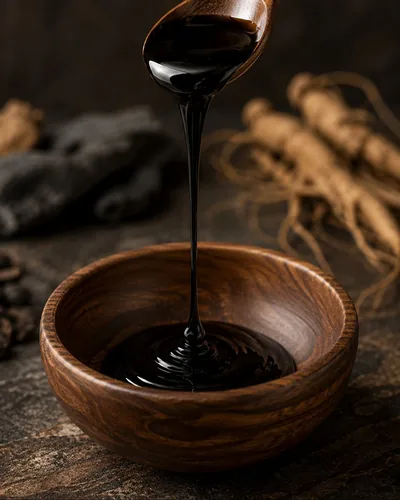


There is a version of ginseng that does very little, and it is the version most people have tried. It comes as a capsule with an impressive-sounding milligram number, tastes of nothing, and produces no discernible effect over a month. This is not because ginseng doesn't work. It's because that product was never really ginseng in any meaningful quantity.
The milligram number is not the number
Most labels give you a weight — 500 mg of "Korean ginseng root powder", say. That figure tells you almost nothing useful, because it doesn't distinguish between dried root milled into powder and a concentrated extract. Powdered root is mostly cellulose and starch: structural plant matter your body can't do much with.
What matters is the extract ratio and the ginsenoside content. A 10:1 extract means ten kilograms of root produced one kilogram of extract. Ginsenoside content — usually given in mg/g — tells you how much of the active compound survived the process.
Not all ginsenosides are equal
There are more than a hundred identified ginsenosides, and they are not interchangeable. The large ones found in fresh white ginseng — Rb1, Rg1 — need to be broken down by gut bacteria into smaller molecules like Compound K before your body absorbs much of anything.
Here's the problem: whether that conversion happens depends on your individual microbiome. Studies have found a substantial share of people simply lack the bacteria to do it efficiently. They can take white ginseng daily and absorb a fraction of what someone else does.
Repeated steaming — the process that makes black ginseng — performs that conversion outside the body. Nine cycles of steaming and drying cleave the sugar groups off, producing Rg3 and Compound K directly. The root does the work your gut might not.
Three things to look for
- A ginsenoside figure in mg/g, not just a total weight. If it isn't there, assume it's low.
- A named origin. "Korean ginseng" is a species, not a provenance. Geumsan, Punggi, Ganghwa — these are places with reputations that can be damaged.
- A certificate of analysis you can actually read. Heavy metals, pesticide screen, microbials, and the ginsenoside panel. Anyone can write "third-party tested" on a box.
And one more thing
It should taste bitter. Genuinely, assertively bitter — the kind of taste that makes you pause the first few times. That bitterness is the ginsenosides themselves. A ginseng product that tastes pleasant has either been diluted heavily or sweetened to cover the absence of anything worth covering.
Ours is 30% concentrate and 70% purified water — no honey, no sweetener, nothing to round the edge with. You'll notice. That's deliberate.