

The science
Nine steams,
and what they leave behind
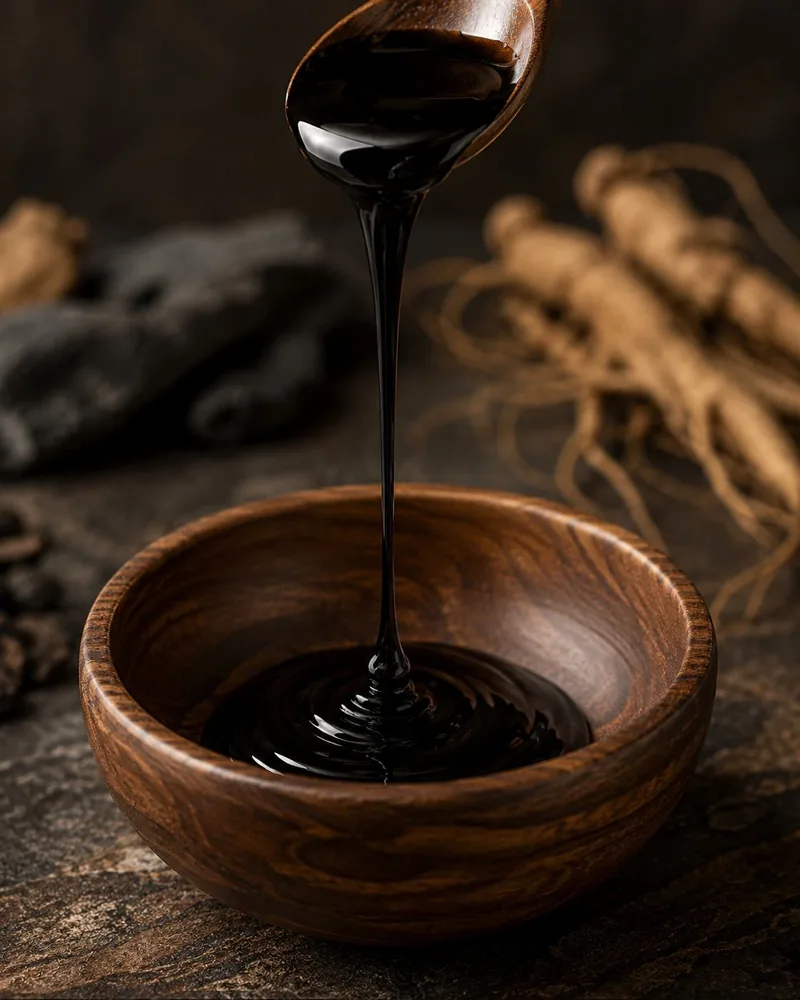
Black ginseng is not a marketing name. It is what happens to Panax ginseng after nine cycles of steaming and drying.

The transformation
Fresh root
Why fermented
Your gut was going to
do this anyway
Raw ginseng carries its ginsenosides mostly as large molecules — Rb1, Rg1 and their relatives. Molecules that size are poorly absorbed in the small intestine, so the body relies on gut bacteria to cleave the sugar groups off them first and produce smaller, more absorbable forms.
That step is the catch. The conversion depends on which bacteria a person happens to carry, and studies of the relevant enzymes find the capacity varies widely between individuals — a substantial proportion convert poorly or not at all. Two people can take an identical dose and absorb very different amounts.
Fermentation performs that conversion before the stick is sealed, using controlled microbial cultures rather than whichever flora you woke up with. The work is already done when you drink it.
- Compound K
- The best-studied of those smaller forms — the metabolite gut bacteria normally have to produce from Rb1. Because fermentation makes it in advance, it is present in the extract itself rather than depending on your digestion to create it.

Ginsenoside spotlight
What a ginsenoside
actually is
Ginsenosides are the saponins found in Panax ginseng — and essentially only there. They are the reason the plant has been studied for centuries rather than eaten for nutrition; the root is otherwise unremarkable.
More than a hundred have been identified. They are not interchangeable: they differ in molecular size, in how readily the body absorbs them, and in which effects the research associates with them. A label that gives you a total milligram weight and no ginsenoside figure is telling you about plant matter, not about the compounds.
They are also what you are tasting. Saponins are bitter — that is the same class of compound doing both jobs, which is why a ginseng that tastes of nothing is usually a ginseng that contains very little.
- Saponin
- A class of plant compound named for its soap-like foaming in water. Ginsenosides are the saponins specific to Panax ginseng.
What changes
The compounds that matter
-
Rg3 — the rare ginsenoside
×8
Nearly absent in raw ginseng — it's created by repeated steaming. The compound most associated with stress resilience in the literature.
-
Compound K — the absorbable form
×5
The form your body can actually use. Normally your gut bacteria have to make this conversion — and many people's don't. Fermentation does it first.
-
Rb1 / Rg1 — the classics
×2
The well-studied baseline compounds, concentrated further by filtering out inedible biomass.
Multipliers compare our fermented black ginseng extract against raw Panax ginseng of the same grade. Batch-specific figures are on each COA.
Taste
Why bitter is
good for you
Bitterness is not a flaw in the process, it is the ginsenosides announcing themselves. The saponins responsible for the taste are the same compounds the extract is measured on, so the intensity tracks the concentration rather than fighting it.
Bitter compounds are also detected well beyond the tongue — bitter taste receptors have been identified throughout the digestive tract, and a bitter stimulus is associated with digestive responses that begin before anything is absorbed. It is a signal your body is built to read.
Which is why nothing has been added to mask it. No honey, no sweetener — 30% concentrate, 70% purified water. It passes in well under a minute, and most people stop noticing by the end of the first week.
Read a batch COACertificate of analysis
Read the lab report
Every batch is tested by an independent lab and ships with its COA. Most supplement brands claim testing. Far fewer let you read it. Pick a batch: